
Buncombe Parole and Probation Compared
A person can be outside a prison or the Buncombe County Detention Facility while still answering to a correctional agency. North Carolina Department of Adult Correction Community Supervision administers probation, parole, and post-release supervision in the field. The North Carolina Post-Release Supervision and Parole Commission sets post-release conditions and makes decisions for the remaining parole-eligible group.
The label matters. Probation is a court-ordered sentence or suspended-sentence status. Parole is discretionary release for eligible older-law cases. Post-release supervision is the statutory period that follows prison release for many Structured Sentencing terms. Physical release begins that status; it does not mean unconditional discharge.
| Status | How it begins | Who administers it |
|---|---|---|
| Probation | A court orders community supervision, often with a suspended sentence. | NCDAC Community Supervision carries out the court's terms. |
| Parole | The Commission grants release in an eligible legacy case. | The Commission sets terms; Community Supervision manages field contact. |
| Post-release supervision | A modern prison term reaches its statutory supervision release point. | The Commission sets conditions; Community Supervision administers them. |
| Pretrial supervision | A judicial official releases a person while charges remain pending. | Buncombe Pretrial Support Services may monitor eligible, consenting participants. |
- Discharge
- The formal end of the supervision term or sentence status.
- Absconder
- A person whom NCDAC identifies as avoiding community supervision.
- Revocation
- An official decision that can return a supervised person to custody after a violation.
Verify Buncombe Post-Release Supervision
The NCDAC Offender Public Information Search is the first public check. It includes state prisoners, probationers, parolees, and historical records dating to 1972. It excludes ordinary county jail records. Search “All” when the end status is uncertain, since a person may have moved from active inmate to active supervision or inactive status.
- Search by the seven-digit offender number when known. Leading zeros are not required. Otherwise start with surname and given name.
- Compare middle name, birth data, and offender number. Do not select a match from the name alone.
- Open the detail record and read Inmate Status and Probation/Parole/Post Release Status separately.
- Review each incarceration and supervision period. Match the conviction county, docket, admission, actual release, and parole or supervision dates.
- If the public record is unclear, call the district office with the offender number and ask only for public status and the correct office.
An “inactive” result is broader than a prison release. It means the person is no longer active in the selected NCDAC category. Sentence and supervision history must show what ended. The dedicated state Inmate Release Search can establish a state-prison release event, but it cannot prove a release from BCDF. For the county event itself, use the Buncombe County released-inmate search paths and request the jail-management release or transfer event.
Note: A probation record does not by itself prove that the person served a state-prison sentence or left BCDF on a stated date.
Buncombe Supervision Office Contact
NCDAC lists Buncombe's Community Supervision office as Judicial District 28. That district number differs from the local court district references used by Buncombe programs, so name the agency and purpose when calling. Detailed supervision files remain confidential under N.C.G.S. § 15-207. The public inquiry should seek status, office assignment, and a way to deliver information, not a case officer's full file.
NCDAC Community Supervision, Judicial District 2860 Court Plaza, 13th Floor
Asheville, NC 28801
Phone: 828-255-6412
Fax: 828-232-2261
Have the offender number ready. A district office can help distinguish active supervision from a closed record, but it is not the source for a county jail release timestamp or a federal supervision record.
Buncombe Parole Eligibility Rules
North Carolina eliminated discretionary parole for offenses committed on or after October 1, 1994 under Structured Sentencing. Those cases may involve post-release supervision, but that is not a parole grant. Older Fair Sentencing and other legacy cases can remain eligible under the law in force when the offense occurred. The judgment, offense date, sentence type, and any exclusions control.
The Commission cautions against a universal eligibility calculation. Fair Sentencing felony cases involving offenses from July 1, 1981 through September 30, 1994, with terms of at least eighteen months, may also involve special mandatory-parole provisions. A public record should be read against the actual judgment instead of applying a modern rule to an older case.
Buncombe Parole Review Records
North Carolina does not use the conventional public parole hearing shown in some other states. The Commission's official parole explanation says commissioners review files and vote independently. They do not meet as a group in a formal hearing or ordinarily meet face-to-face with the person. A narrow video-review exception exists for certain juvenile-convicted life-with-parole candidates.
The Discretionary Parole Reviews page publishes monthly reports beginning in September 2024. Annual eligibility, Mutual Agreement Parole Program, and medical-release reports provide added context. Results may include approval, denial, continued review, an incomplete decision, suspension, conditional action, rescission, or later revocation. “Incomplete Decision” means more information or investigation is needed. It is not a grant or denial.
Cases are generally reviewed at least once a year after eligibility. The Commission says first- and second-degree murder cases may be reviewed every three years, while sexually violent offense cases in that group may be reviewed every two years. A majority vote approves or denies parole, and there is no appeal from the Commission's exclusive decision. Detailed deliberations remain confidential, so the dated public report and offender history are the useful verification pair.
The official explanation of North Carolina's file-review process is shown in this Commission source.
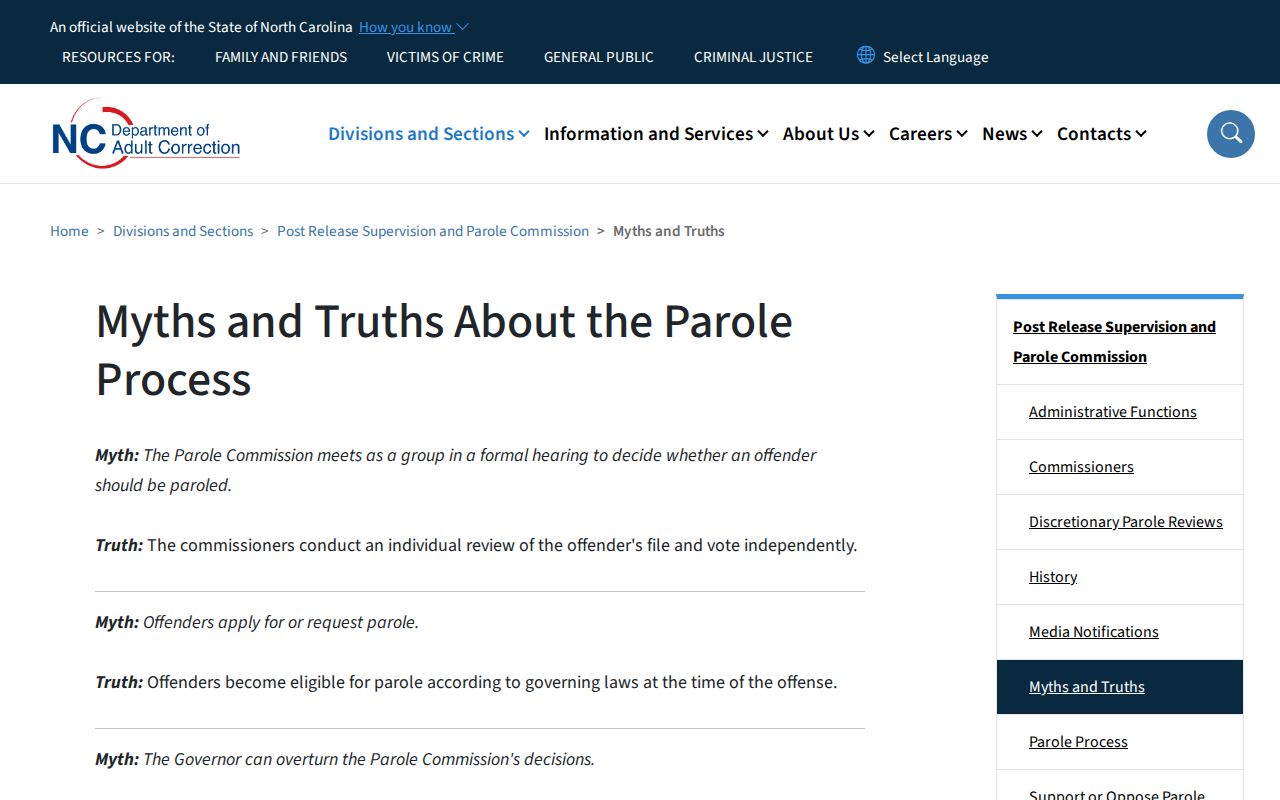
The image helps identify the correct state process and prevents a search for a local public hearing calendar that does not exist.
Buncombe Supervision Violations and Absconders
Conditions vary with the order and governing law. They may be continued or changed during supervision. An alleged violation can lead to preliminary and final procedures, a modification, or revocation and reimprisonment. A return to prison after a violation does not make the prior release record false. It describes a later custody episode.
The official NCDAC Absconded Probationer Search accepts a last name and county of supervision. A match means NCDAC identifies the person as having absconded. It does not prove current physical incarceration. Confirm a warrant or custody event with NCDAC or law enforcement.
Note: A missed appointment alone is not public proof of absconder status, a warrant, or a new arrest.
Buncombe Warrants After Release
Buncombe's official channel differs from the statewide absconder list. The sheriff's published guidance directs warrant questions to the Magistrate's Office at 20 Davidson Drive. No county online named absconder list was located in the official channels reviewed. That makes it important to avoid blending a state supervision status with a county warrant inquiry.
A later warrant can explain why a released person returns to BCDF. It does not erase the first release. Compare dates and case numbers: first identify the prior release or transfer event, then check whether the new warrant led to a fresh booking. If the person is alleged to have violated parole or post-release supervision, Commission procedures can also lead to revocation and state custody.
Buncombe Pretrial Support Is Different
Buncombe Pretrial Support Services monitors eligible, consenting people released while cases remain pending in the 40th Judicial District. That is not probation, parole, or post-release supervision. The distinction is practical: a person can be out of BCDF, make weekly check-ins, and still have no conviction or state supervision record tied to that case.
The program is at 60 Court Plaza, 14th Floor, Asheville. Its main line is 828-250-6294, the client line is 828-250-6285, and the direct automated line is 828-248-0625. Published hours are weekdays from 8 a.m. to 5 p.m. The county also states that electronic monitoring ended May 21, 2025. These details can confirm the local reporting route, but they do not supply the exact BCDF release time.
Buncombe Reentry After Release
Buncombe County's Jail Diversion and Re-Entry Services adds a local support layer that is separate from correctional supervision. Jail-based planning is open to anyone housed at BCDF, and referrals may come from the person, family, jail staff, counsel, providers, or judges. The program also includes JUST post-booking diversion and Familiar Faces/FUSE coordination.
Participation does not prove parole, probation, or discharge. It can run alongside a court case, local release plan, or supervision term. Verify legal status through the NCDAC record and the governing order; use the county program for planning and referrals.
Buncombe Supervision Discharge Records
Supervision ends through the controlling term, an authorized discharge, or another order reflected in the official history. The NCDAC record may show parole begin and end dates, post-release status, sentence service status, and separate periods of supervision. Read all periods because a person can move from prison release to active supervision, then later become inactive.
NC SAVAN can send custody or supervision alerts from a participating source, but an alert is not the full discharge record. Confirm the end status through NCDAC. For a county probation judgment, also inspect the Buncombe eCourts case and order. Keep county pretrial monitoring, state probation, state post-release supervision, federal supervised release, and unconditional discharge in separate categories.