
No Buncombe 72 Hour Release Feed
No distinct official Buncombe County three-day named release page was found. The P2C Detainee Search is a current-custody tool, not a former-detainee archive. The county also offers a Booking & Release Trends Dashboard, but its counts are aggregate. Neither source can be relabeled as a 72-hour roster.
The distinction matters over three days. A person can disappear from the live catalog because BCDF recorded a community release, a transfer, or another custody change. No official P2C retention period, update cadence, release filter, or release-reason field was located. A vanished entry must be checked against the jail-management event, the court file, and a receiving system when one is named.
Define Buncombe's Three-Day Window
“Last 72 hours” should mean a fixed seventy-two-hour interval, not three loosely described calendar dates. Record the local start and end timestamps before contacting the sheriff. This keeps an overnight event from falling outside the request and prevents two offices from interpreting “the weekend” differently.
For one person, request the exact existing booking, release, discharge, or transfer event for the relevant incarceration. A single record is often more precise than asking staff to compile a list that may not exist. For a group of events, ask whether the agency already maintains a release-event export for the defined period. Chapter 132 gives access to existing public records, subject to exceptions; it does not require staff to create a new analysis.
| Window element | How to state it | Why it matters |
|---|---|---|
| Start | Exact date and local time | Includes late evening or early morning events without guesswork. |
| End | Exact date and local time | Defines when the check stops and permits a later recheck. |
| Identity | Full name plus booking or case number | Separates people with similar names and multiple bookings. |
| Event scope | Release, discharge, and transfer | Prevents a custody transfer from being hidden by a narrow wording choice. |
Note: A same-day event is better handled through the Buncombe 24-Hour Release List workflow, while this window is designed to span three full days.
Check Buncombe 72 Hour Releases
The wider Buncombe County release inquiry should preserve the sequence of custody. Search first, then document the event and any next destination.
- Write the exact three-day start and end times. Keep the time zone and the current check time in the notes.
- Search P2C for current BCDF custody. Treat a match as a present-custody indicator subject to update timing, not a three-day history.
- Review the Buncombe eCourts case for bond orders, dismissals, judgments, time-served entries, and other public events that could explain release.
- Submit a narrow request through the Sheriff's NextRequest portal for the existing jail-management release or transfer record.
- When the event names NCDAC, another jail, federal custody, or immigration custody, continue with that receiving system before calling the departure a community release.
- Compare any NC SAVAN/VINELink alert with the source agency and event timestamp. Alert wording should be preserved exactly.
The request should include full name, date of birth if known, booking number, court file number, and approximate admission date. Ask for the release date and time, event type, authority, and receiving agency or destination if recorded. This gives staff a defined record target without asking them to determine where the person is now.
The official request portal is the main historical fallback for Buncombe County jail release records.
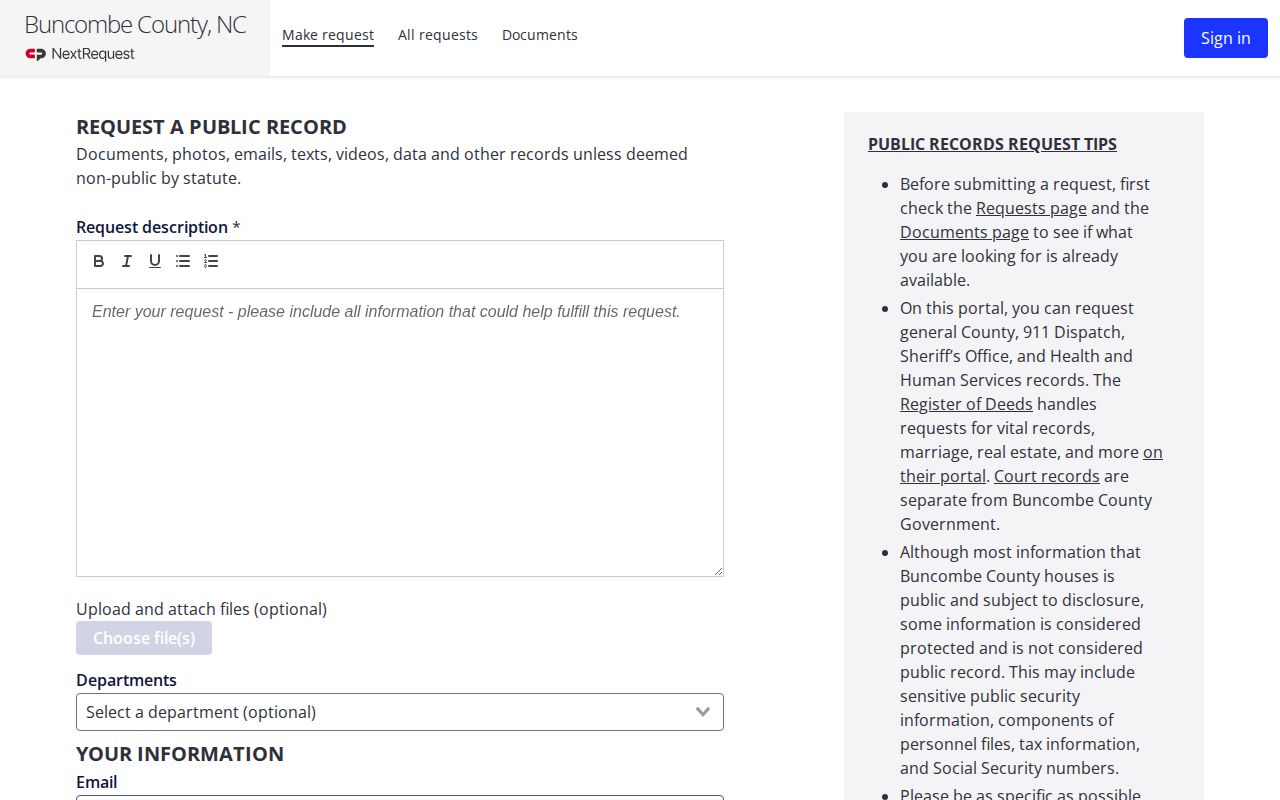
Its request process can preserve the exact interval and booking identifiers that a rolling roster would otherwise supply.
Buncombe Weekend Release Checks
BCDF operates continuously, and the sheriff says releases are processed around the clock on judicial instruction. Thus, a valid release may be completed overnight or during a weekend. Administrative records access and court-office contact do not necessarily follow that same schedule. A Monday inquiry may need to reconcile events from Friday night through Monday morning.
Do not assume that weekend timing changes the legal basis for release. The court order still controls, and staff must check all cases and holds before carrying it out. A disposition such as dismissal or time served may explain one matter while a second charge, secured condition, or another agency hold continues custody. Conversely, an overnight jail event may be valid even if the public court display is reviewed later.
A court calendar is only a schedule. It can point to a hearing that may generate an order, but it is not proof that the hearing occurred or that a person physically departed. The recorded judgment or order and the BCDF event are stronger evidence.
A long weekend can also cross two reporting systems. A judicial release may lead to Buncombe Pretrial Support Services while the criminal case remains pending. That local status is not probation or parole, and it does not supply the jail's door-out time. A state-prison release may begin NCDAC post-release supervision, which remains part of the sentence structure. Each community status should be read from its own official record rather than inferred from the absence of a jail listing.
When the exact release day is unknown, search the court events across the whole interval and ask BCDF for the one matching incarceration. A Friday order, Saturday jail event, and Monday records response can all describe the same lawful sequence without showing a data error. Preserve each timestamp and its source before resolving the chronology.
Note: Recheck dynamic sources after office records become available, since no reviewed Buncombe source promises an immediate public update after every release.
Buncombe 72 Hour Release Fields
No official three-day list means there are no verified public list columns to reproduce. The most useful substitute is a field inventory for the existing jail-management event. It ties each claimed release to one custody episode and reveals whether departure was a transfer.
| Field | Reading the result |
|---|---|
| Name and identifiers | Match the person to the correct booking and avoid name-only assumptions. |
| Admission timestamp | Sets the start of the incarceration being checked. |
| Release timestamp | Places the event inside or outside the defined 72-hour range. |
| Case or charge | Connects the custody event to the court file without implying all other matters ended. |
| Event description | Preserves the agency's own term for release, discharge, or transfer. |
| Authority and destination | Explains who directed the action and whether another custodian received the person. |
The county fee schedule says an emailed PDF is free. It also lists a county-provided flash drive, hard copies, certified copies, and postage charges, with a possible actual-cost special charge for extensive technology or staff use. No guaranteed turnaround was found. North Carolina law instead uses the context-dependent standard “as promptly as possible.”
North Carolina's public-records chapter supplies the request framework.
The official Chapter 132 public-records statutes set the access framework for this defined release-record request.
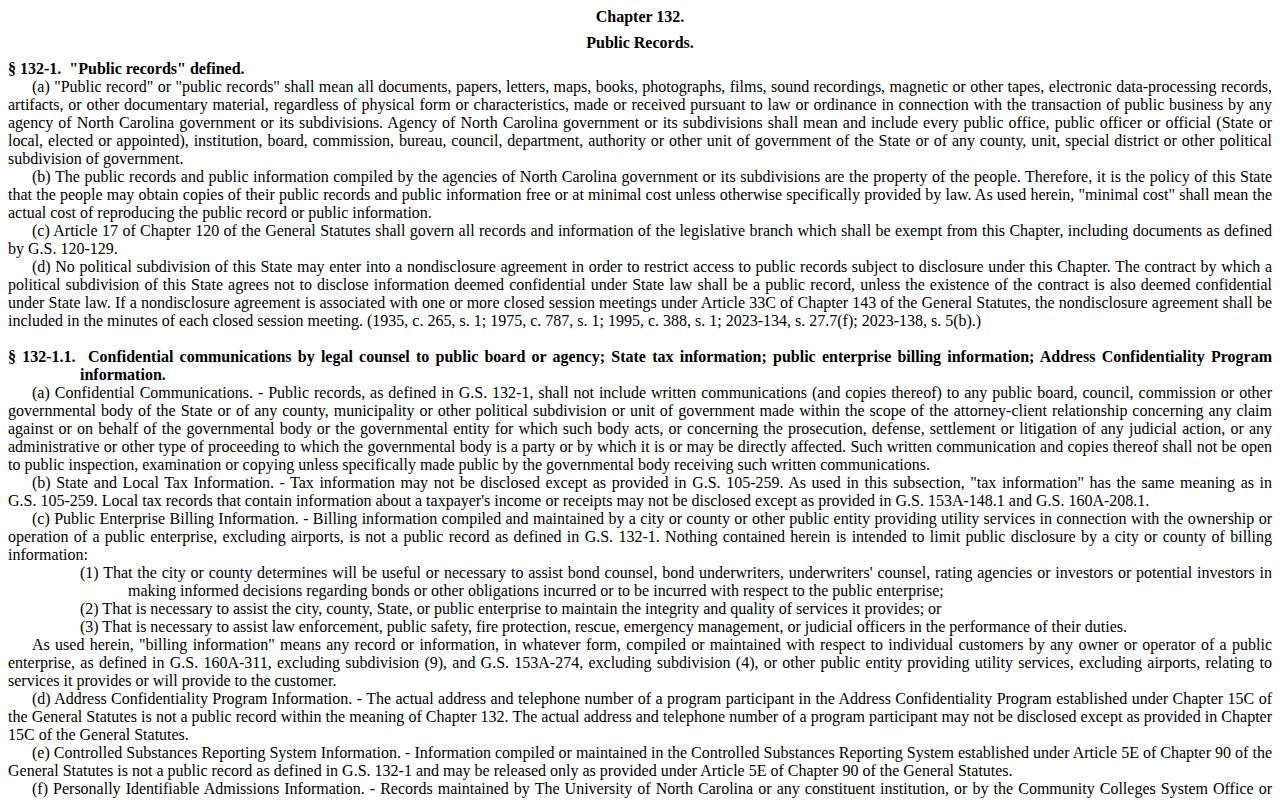
The statute supports access to existing public records, while specific confidentiality, sealing, and expunction rules can still limit disclosure.
Buncombe Release Records by Custodian
A three-day check can cross agency lines. BCDF records a local release or transfer. The North Carolina Department of Adult Correction records state-prison admissions, releases, and community supervision, with public historical data dating back to 1972. It does not hold ordinary county jail records. A person moved to state prison may therefore be absent from P2C and newly visible in NCDAC without ever entering the community.
NC SAVAN/VINELink can send a custody-change alert based on a participating source. It is an alert layer, not the legal custodian of the release record. Match the agency and exact status. For a federal pretrial transfer, use the federal court record and the physical custodian; a Bureau of Prisons record may appear only after sentencing and designation. An immigration handoff is also a transfer and requires the proper federal locator or office.
- County jail release
- Confirm through the BCDF event and the court record that authorized it.
- State prison release
- Confirm through NCDAC actual release history and read any active supervision status.
- Federal departure
- Separate a USMS movement from a later BOP release and use the federal case order.
- Community release
- Do not claim it when the event names a receiving jail, prison, or agency.
The Buncombe County released inmates search is the broader route when the likely custodian is not yet known.
Keep agency departure and unrestricted release separate throughout the full three-day timeline. That one distinction prevents most false matches across P2C, NCDAC, federal, and notification records.