
Craggy Release and Transfer Paths
Craggy Correctional Center is a male medium- and minimum-custody prison operated by the North Carolina Department of Adult Correction. It is not a county jail and does not belong in the Buncombe P2C detainee search. A person can leave Craggy through discharge, release to required post-release supervision, legacy parole, or transfer to another NCDAC institution. Each outcome creates a different state record.
Physical departure is only the first fact. A transfer keeps the prison sentence active at a new location. Release to post-release supervision ends the prison portion but begins a community-supervision period. An unconditional discharge ends the covered correctional status. The NCDAC offender history connects those stages through the same seven-digit offender number.
| Craggy departure | Meaning in the state record |
|---|---|
| Another NCDAC prison | Transfer, with active inmate status and a changed location |
| Post-release supervision | Physical prison release followed by active community supervision |
| Legacy parole | Release under Commission authority for an eligible older-law case |
| Sentence expiration | Actual release tied to the completed sentence, subject to any other custody |
| Inactive record | Formerly active status that requires history review to explain what ended |
Confirm a Craggy Release
The NCDAC Offender Public Information Search contains current and historical information back to 1972 for state prisoners, probationers, and parolees. It expressly excludes county jail data. Search All when the end status is uncertain, then use the detailed record to distinguish a facility move from an accomplished release.
- Search by the seven-digit offender number when known. Leading zeros are not required. Otherwise begin with surname and given name.
- Compare the person’s name, age, middle name, and offender number before opening a result. Similar names can represent different people.
- Read Inmate Status, Incarceration Status, Current Status, Current Location, and Previous Location for the custody path.
- Open the incarceration and sentence history. Compare Admission Date, Actual Release Date, Projected Release Date, and the sentence service fields.
- Check Probation/Parole/Post Release Status to see whether prison release began community supervision.
A move away from Craggy during the closure transition is not release unless the NCDAC history records an actual release event or discharge.
Craggy State Release Search
North Carolina also provides a dedicated Inmate Release Search. It searches state-prison releases by release county, year, month, surname, and a “last name sounds like” option. Buncombe is county code 11. During July 2026 research, the year selector offered 2024 through 2026, but that interface window does not establish a destruction or retention rule for older state files.
Results show Offender Number, Last Name, First Name, Middle Name, Release Date, Primary Offense with qualifier, and Type of Release. Observed Buncombe results included EXPIRATION and PAROLE/RETURN TO PAR. “Release county” in this tool is an NCDAC state-prison field. It does not prove release from Buncombe County Detention Facility.
Use a likely county, month, and name to locate a row, then open the detailed offender record. Match the offender number and identity. Compare the actual release field with the projected date and read the supervision field. This two-step check is stronger than relying on a single results row.
Note: Release county in the NCDAC tool is not proof of discharge from Buncombe County’s local jail.
Craggy Offender Record Fields
A detailed NCDAC record can preserve a long correctional timeline after the person is no longer assigned to Craggy. The public system may show an offender photograph, demographics, status, location, previous location, projected release, admission, and periods of incarceration or supervision. Sentence history supplies the context needed to interpret the release.
| State field | How to read it |
|---|---|
| Current and previous location | Shows whether a Craggy departure was followed by another NCDAC assignment |
| Projected Release Date | Current calculation, not proof that release occurred |
| Actual Release Date | Recorded completion of the prison release event for that sentence period |
| Sentence Status and Service Status | Shows how the sentence entry stands within the history |
| Probation/Parole/Post Release Status | Identifies active or historical community supervision |
| Admission and sentence dates | Tie the release to a specific period and judgment |
An “inactive” person was formerly active but is no longer active in the selected state status. It is broader than “released from Craggy.” Review every relevant incarceration and supervision period before describing the final outcome.
Craggy Closure Transfer Checks
The official Craggy facility page says the institution is winding down for closure in late summer 2026. During that change, disappearance from a Craggy assignment is especially likely to reflect a transfer. The statewide record remains authoritative even after the building closes because NCDAC, not the facility page, maintains sentence, admission, movement, release, and supervision history.
Check Previous Location and Current Location along with the status line. A new prison name supports an internal transfer. A release date paired with active post-release status supports physical release into supervision. If the public display lags or leaves the sequence unclear, request public admission and release dates from NCDAC using the offender number.
The archived facility image below captures the NCDAC release-search context used for Craggy record checks.
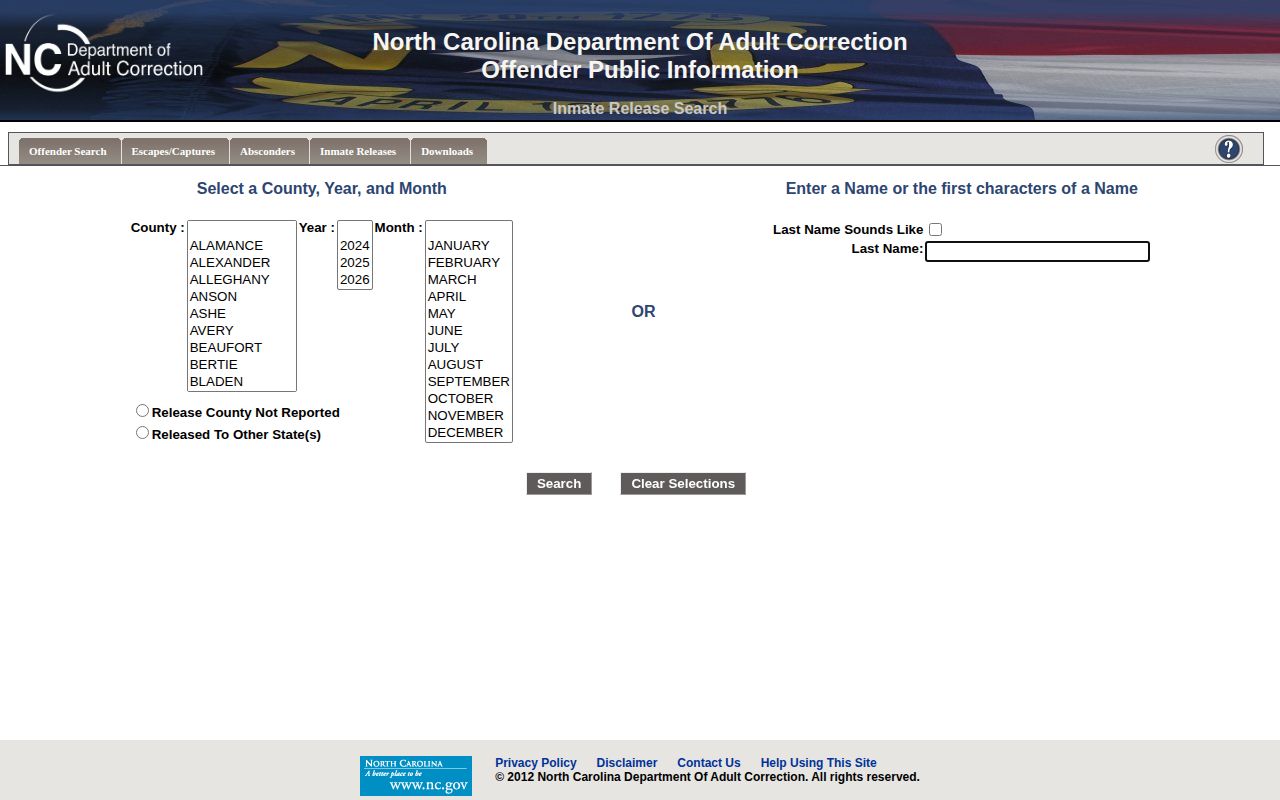
The statewide search remains useful when the Craggy page changes or the physical facility is no longer operating.
Craggy Projected Release Dates
A projected release date is NCDAC’s best current calculation, not the physical release event. Earned or disciplinary credits, work or program changes, court action, resentencing, corrections to concurrent or consecutive terms, escape time, changes in law, and Commission action in a parole-eligible case can alter it. Removal from a qualifying work or program assignment can also change the calculation.
North Carolina Structured Sentencing applies to offenses committed on or after October 1, 1994. NCDAC explains that the system requires service of at least the minimum and permits earned time to reduce the maximum only within the governing rules. Section 15A-1340.13 supplies the minimum and maximum framework, while section 148-13 authorizes NCDAC credit rules. A simple statement that every North Carolina prisoner serves a fixed percentage would be inaccurate.
After the expected date, return to the state history and look for Actual Release Date. If the record shows community supervision, physical release did not yet mean unconditional discharge.
Note: Recheck the state record after a projected date passes because the projected field does not record physical release.
Craggy Post-Release Records
Post-release supervision is part of North Carolina’s modern sentence structure. The Post-Release Supervision and Parole Commission sets conditions, while NCDAC Community Supervision administers the person’s status in the field. Violations can lead to revocation and imprisonment, so a history can legitimately show release, supervision, violation, and return to prison.
Legacy parole applies to a narrower older-law population. Structured Sentencing ended ordinary discretionary parole for offenses on or after October 1, 1994. The offense date and judgment decide which framework applies. The public record should be read as written instead of labeling every supervised release as parole.
For a Buncombe-area supervision question, the NCDAC Community Supervision office is listed at 60 Court Plaza, 13th Floor, Asheville, NC 28801, phone 828-255-6412. Public status can be checked, but detailed supervision files remain confidential under state law.
Craggy Records and Contact
The official page lists separate contacts for the medium and minimum units. Administrative availability can change during closure, so use NCDAC’s current directory and public-record contact when a local line no longer answers.
Main unit: 828-645-5315
Minimum unit: 828-645-7630
Street references: 22 Canoe Lane and 2992 Riverside Drive
Asheville, North Carolina
NCDAC’s public-records page identifies conviction, time served, sentence length, admission dates, and release dates as basic public information. Internal behavior, classification, and much of the prison file are confidential. Ask for the public fields tied to the offender number rather than the full institutional file.
The public-record headquarters contact is 214 West Jones Street, Raleigh, with mailing at 5201 Mail Service Center, Raleigh, NC 27699-5201, and general phone 919-733-2126.
Craggy Correctional Record History
The official account traces the older Craggy facility to 1924 and state assumption under the 1931 Conner Bill. The current institution consolidated with Buncombe Correctional Center in March 2014. NCDAC lists 416 medium-custody beds and 182 minimum-custody beds. Those facts describe the institution and its history, not any one person’s custody outcome.
A historical facility name may still appear in an older sentence or movement record. Follow the offender number and event dates rather than assuming a renamed, consolidated, or closed prison erased the trail. The statewide database is designed to preserve that continuity.
For county-jail cases that never entered NCDAC custody, use the Buncombe County Detention Facility release route. The sheriff’s P2C search covers current local custody, while NextRequest is the positive-event records fallback. A matching Buncombe court file can explain the judicial outcome. Craggy’s state search cannot certify an ordinary BCDF bond-out.
Note: State prison history and the county jail event answer different release questions and should not be merged.